By Todd Burley and Pan Kantiyavong, Seattle Parks and Recreation
Seattle Parks and Recreation (SPR) is all-in on native plants, having recently updated our Native Plant Policy and integrating this value into our plans and landscapes. It is likely when you think of Seattle’s native plants, species like Western redcedar, salal, sword fern and Douglas firs come to mind. Yet SPR also brings the native plants of other parts of Washington State right to our parks in special collections.

A recently opened exhibit at the Volunteer Park Conservatory Cactus House features the three native cacti indigenous to our state. There is no need to travel to central Washington to see these amazing succulents. The new exhibit features the Columbia prickly-pear (Opuntia columbiana), the brittle prickly-pear (Opintia fragilis), and the Columbia Plateau cactus (Pediocactus nigrispinus). In partnership with Mr. Ron Bockelman, retired Senior Conservationist at the UW Burke Herbarium, educational signs describe each plant, including distribution.
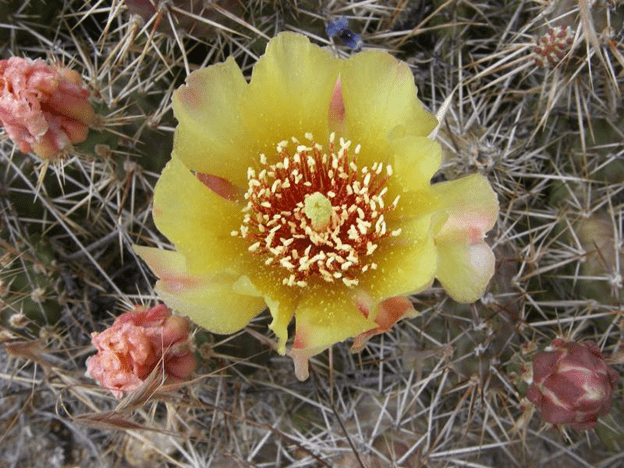
Cacti are desert plants known for their thick, water-storing stems and protective spines. They are specially adapted to survive in harsh, dry environments with little rainfall. They have spines instead of leaves, store water in their stems, and have a special form of photosynthesis that conserves water.
Most cacti cannot survive freezing temperatures, which is why most species are found in warm southern climates. But there are several cold-hardy species, including the three that occur naturally in Washington.
We are excited to share that our own staff have been part of a proposal to establish an official State cactus, the Columbia Plateau cactus, our only “ball” cactus. Senate Bill 5325 – sponsored by Senators Warnick, Nobles, Riccelli, Shewmake, and Valdez, and supported by the Washington Native Plant Society and the Cascade Cactus and Succulent Society – is currently going through the legislature and was passed by the Senate committee.

You can see these cacti right in Seattle! The Volunteer Park Conservatory is open to the public from 10:00 a.m. to 4:00 p.m. daily, except on Mondays when it is closed all day.
To learn more about conservation efforts to promote, and to protect Washington state native cacti and its habitat, check out these published research articles.
- Bockelman, R.J. 2020. Pediocactus nigrispinus – Washington’s Only Ball Cactus. Douglasia 44(1): 2. (Spring 2020)
- Bockelman, R.J. 2020. Fascinating Fasciated Ball Cacti. Douglasia 44(3): 17 (Fall/Winter 2020).
- Bockelman, R.J. 2021. Phenology of Pediocactus nigrispinus in the Shrub Steppe of Central Washington. Douglasia 45(1): 13-17. (Spring 2021)
- Bockelman, R.J. 2021. Early Life History of Pediocactus nigrispinus in the Shrub-Steppe of Central Washington. Douglasia 45(3): 5-10. (Fall/Winter 2021)
Bockelman, R.J. 2024. Update: Pediocactus nigrispinus for Washington State Cactus. Douglasia 48(3): 2-5. (Fall/Winter 2024)